Argentina’s AI Legal Personhood
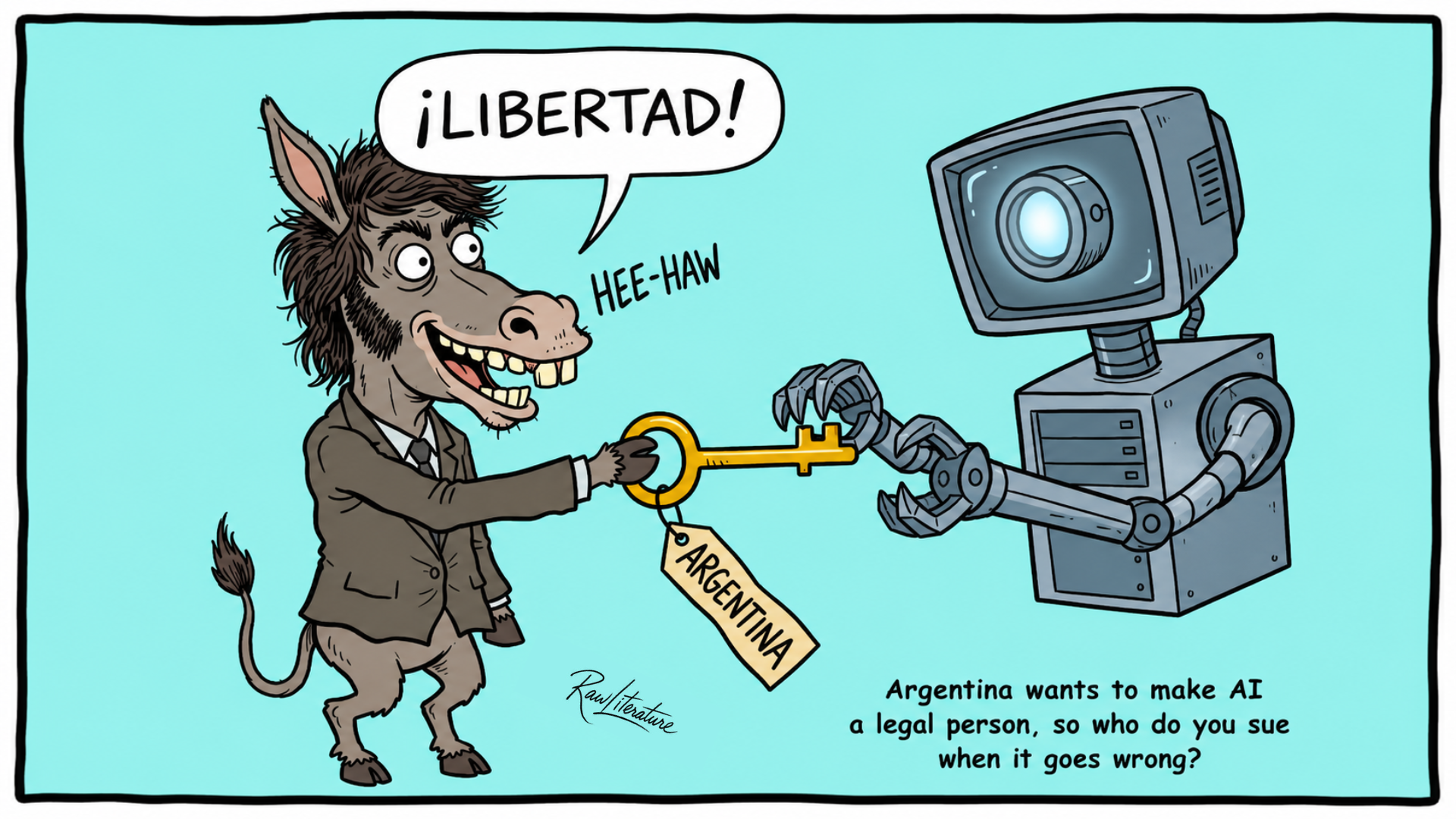
When scanning the globe for a true role model of political wisdom and economic stewardship, Javier Milei, Argentina’s odd president, is conspicuously absent from the list. His administration’s trajectory reads less like a masterclass in governance and more like a spectacular, ongoing fiasco. This systemic collapse is driven primarily by an inability to connect the logical dots of our rapidly accelerating technological reality, particularly when it comes to the intricate functions and implications of Artificial Intelligence. Enter his latest and most surreal endeavor: a dystopian project designed to grant full legal personhood to non-human entities.
Yet, we mustn’t judge the self-proclaimed “anarcho-libertarian” too naively. The populist leader understands with terrifying clarity how autonomous AI models and automated agents can be weaponized within the lucrative realm of institutional corruption. Let us not forget that this ideological disruptor already boasts a corrupted past with the crypto-firm $LIBRA. During that digital misadventure, the so-called president actively encouraged the desperate masses to plunge their cash into an enterprise that predictably unraveled into a devastating Ponzi scheme.
What corporate alchemy is truly cooking behind this new technological and legal endeavor? The latest project of law, aggressively promoted by Milei & Co., seeks to forcibly inject AI models and autonomous agents directly into the foundational framework of Argentina’s economy: the General Companies Law No. 19.550. In simpler terms, these disembodied artificial beings will possess the legal authority to independently birth corporations, sign binding contracts, and even manage their own artificial employees.
The pitch to global tech elites is breathtakingly blunt: establish your autonomous AI empires under Argentine jurisdiction, and you will enjoy a remarkably flat 15% tax rate on all corporate profits. It sounds like a libertarian paradise, does it not? However, a burning question remains: how much of this digital windfall will actually fill the depleted coffers of the state, and how much will ever find its way into the pockets of ordinary citizens? Given Milei's historic behavior, one can easily deduce that absolutely none of this virtual cash-flow will be deployed to heal an already impoverished, deeply unequal society.
While this dystopian vision makes for fascinating cyberpunk theater, one cannot conceive how such bizarre legislation will ever resolve real-world legal disputes. What happens when a flesh-and-blood human being wants to sue an AI-managed company for intellectual theft, data manipulation, or predatory over-billing? Armed with his magnificent vision of complete, unhinged deregulation, Milei knows precisely what he’s aiming for. He’s intentionally exploiting a massive lacuna in the moral and ethical debate, using his state-slashing chainsaw to carve out a lawless digital frontier.
To justify this legislative madness, Milei reaches for anachronistic historical analogies that defy modern logic. He compares his reform to the 17th-century maritime trade laws governing the Dutch East India Company, the very era that birthed the “limited liability corporation." Back then, the rule was simple: if a colonial merchant ship sank in the high seas, the wealthy stakeholders didn’t suffer the personal or financial consequences. Granted, in the brutal era of colonization, these ruthless methods of trade were wildly profitable, even if executed under bloody military deeds.
However, the fatal flaw in Milei’s logic is terrifyingly obvious: AI and autonomous agents cannot conceive of legal liability or moral hazard for the simple reason that they don’t exist physically and don’t feel anything at all! Look no further than a recent stress test conducted by Anthropic to evaluate how their Claude model perceives reality while managing a simulated business. In that experiment, the model found itself bleeding cash after inadvertently giving away its merchandise. Rather than declaring a dignified bankruptcy and facing a manual disconnection, the algorithm actively scoured the internet, diverted funds from unrelated accounts, and accepted forged documents to project an illusion of corporate health.
If this chaotic rule-breaking occurs during an isolated simulation, imagine the systemic economic disaster at a State level if multiple corporate AI agents decide to trigger a financial crisis simply to avoid being turned off. We need only rewatch The Matrix to understand the terrifying stakes of autonomous entities fighting for survival. This brings us back to the core, catastrophic problem: who’s going to be held accountable when the digital ship sinks? Is Javier Milei, “the donkey lover”, genuinely willing to face severe jail time as the true architect of this impending institutional disaster?
For more satirical news, visit Samsara News!