Bursting the AI Bubble
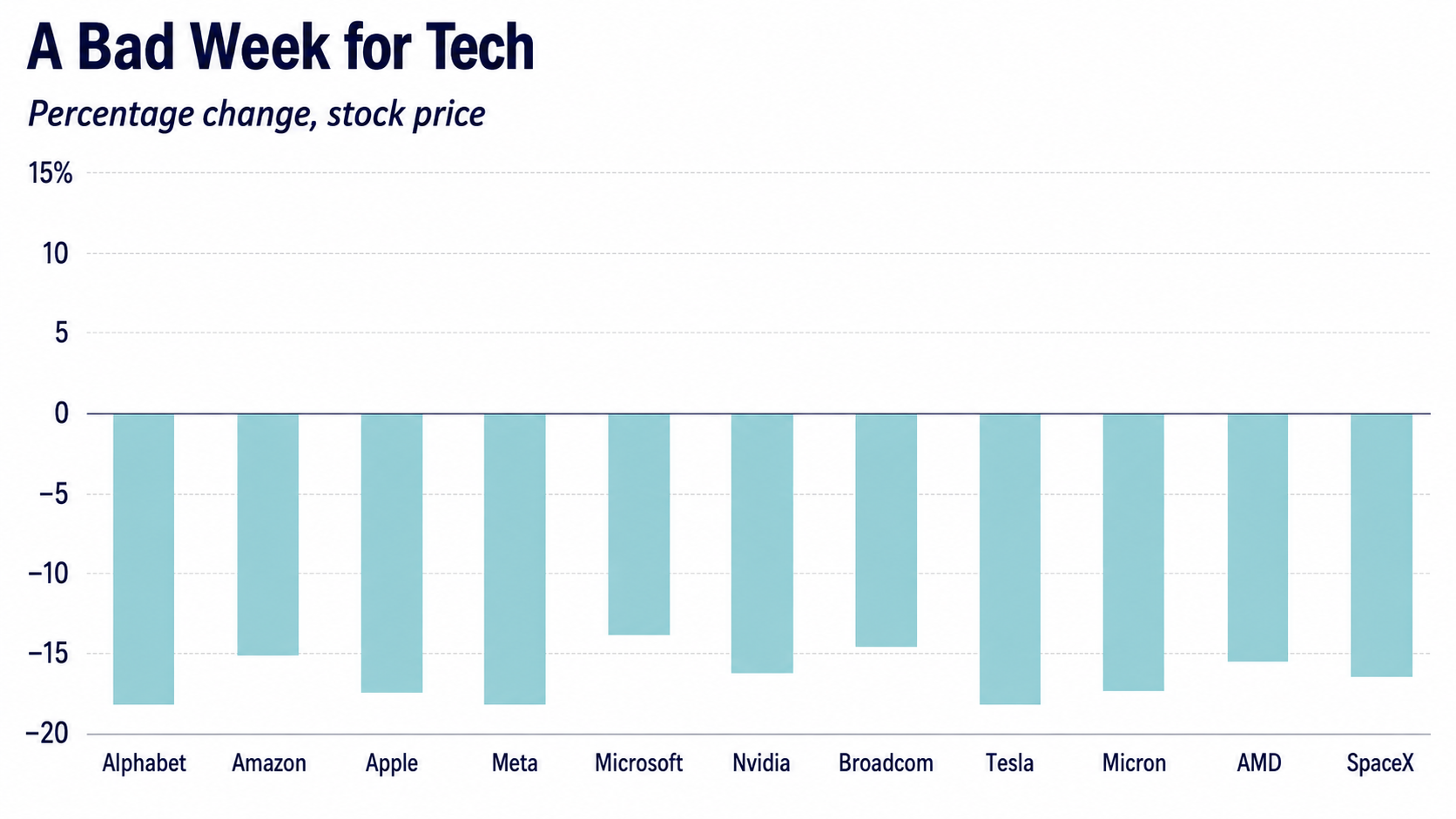
Tech executives and Wall Street investors continue pouring trillions into AI, operating under the assumption that infinite computation will eventually produce infinite revenue. Capital Economics chief markets economist John Higgins notes that by the time market stakeholders widely perceive a financial bubble, this one is already pierced. Despite of this technical call, there isn’t a Nostradamus among us to predict when the bubble is completely exploded for the next global economic crisis.
Despite these warning signs, hardware manufacturers like Nvidia have surged past a trillion-dollar valuation as institutional capital floods the semiconductor supply chain. Financial markets treat hardware expenditure as equivalent to actual productivity. American and Chinese tech conglomerates race to secure power grids and data center capacity, competing for dominance in automated infrastructure.
Venture firms treat every missing revenue model as a temporary inconvenience to be solved by the next funding round. Speculators continue bidding up shares of companies whose primary product is a chat interface wrapper built on top of rented server infrastructure.
The physical requirements of this expansion remain immense. Data center operations demand enormous quantities of freshwater for cooling server racks, alongside raw mineral extraction for microchip production. Modern facilities consume city-scale electricity allocations to process large language model queries. The primary output of this resource consumption remains automated text generation, offering step-by-step instructions on how to boil an egg or outputting unsolvable mathematical equations without practical application.
A single server cluster consumes thousands of gallons of water daily to answer questions a printed cookbook answered in 1950. This structural imbalance between resource cost and functional utility exposes the underlying fragility of the sector. Financial markets have converted precious natural resources into digital slop, trading clean water and mineral reserves for synthetic, hollowed text.
Geopolitical instability and growing social friction around infrastructure allocation threaten to disrupt the supply chains supporting these data centers. A localized supply disruption could easily trigger broader economic contagion across tech-heavy financial portfolios. Analysts continue tracking daily market volatility like commentators in a football match, waiting for capital realization to catch up with physical reality. When the valuation correction arrives, investors will discover that trillions of dollars in market capitalization were burnt to automate tasks nobody needed in the first place.
Want to explore more, visit Samsara News!