Colombia’s Cultural Crusade
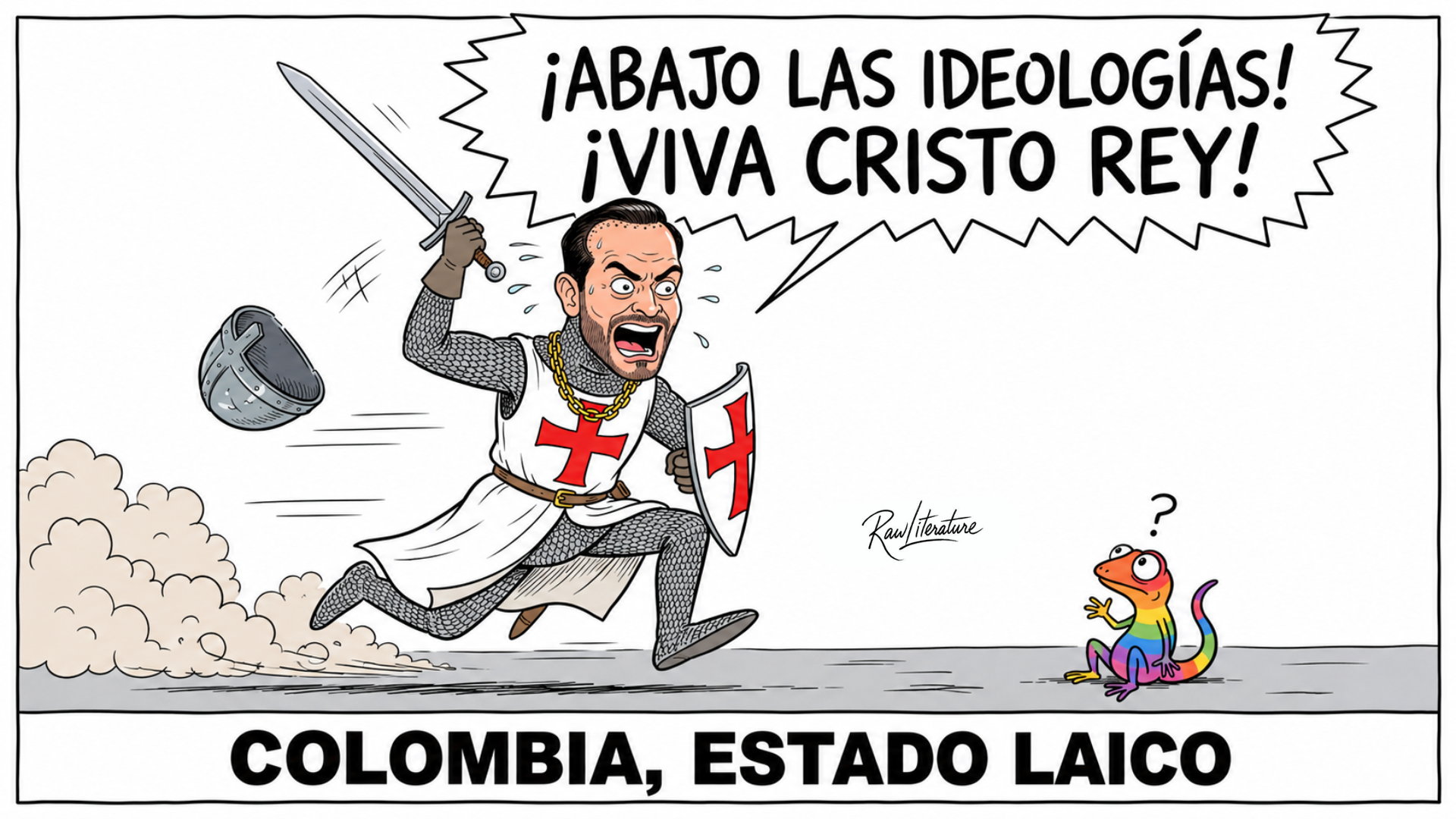
Colombia is living a crusade from the executive branch. Abelardo De La Espriella was an atheist. Then a convenient miracle happened. He decided to turn his faith into the imaginary world of the Vatican. I said convenient because he’s a criminal lawyer and knows what a jury wants to hear. All the work to separate the church from the State is reduced to the so-called “cultural battle.”
A crusade needs an enemy, and the churches that backed De La Espriella’s campaign wanted one too. As major idiocraties across the Americas, like the United States, Argentina, or El Salvador, “wokism” is the grail that must be smashed. The weapons are appointments, believers placed where memory and schooling are made. An imaginary battle turns dangerous once it becomes the system and starts rewriting a country as plural as Colombia.
The Ministries of Culture and Education are the warhorses. Each institution carries a sublime weight to force us to believe in gods and angels and to reject families out of the traditional model. Who the hell are these people to tell us who to love and how to live in family? At Culture we have a female crusader, Paola Holguín, the “generala." A longtime right-wing politician and former senator from the Centro Democrático party with the Catholic Church and the patriarchy at the center of her politics. She designated Sergio Esteban Vélez, a retrograde poet, as director of the Instituto Caro y Cuervo, in which he expects “to work every day to prevent my country from falling into a Communist dictatorship so we won’t lose freedom, democracy, and human rights.” Staff told El Espectador of an “atmosphere of distrust and administrative difficulties.”
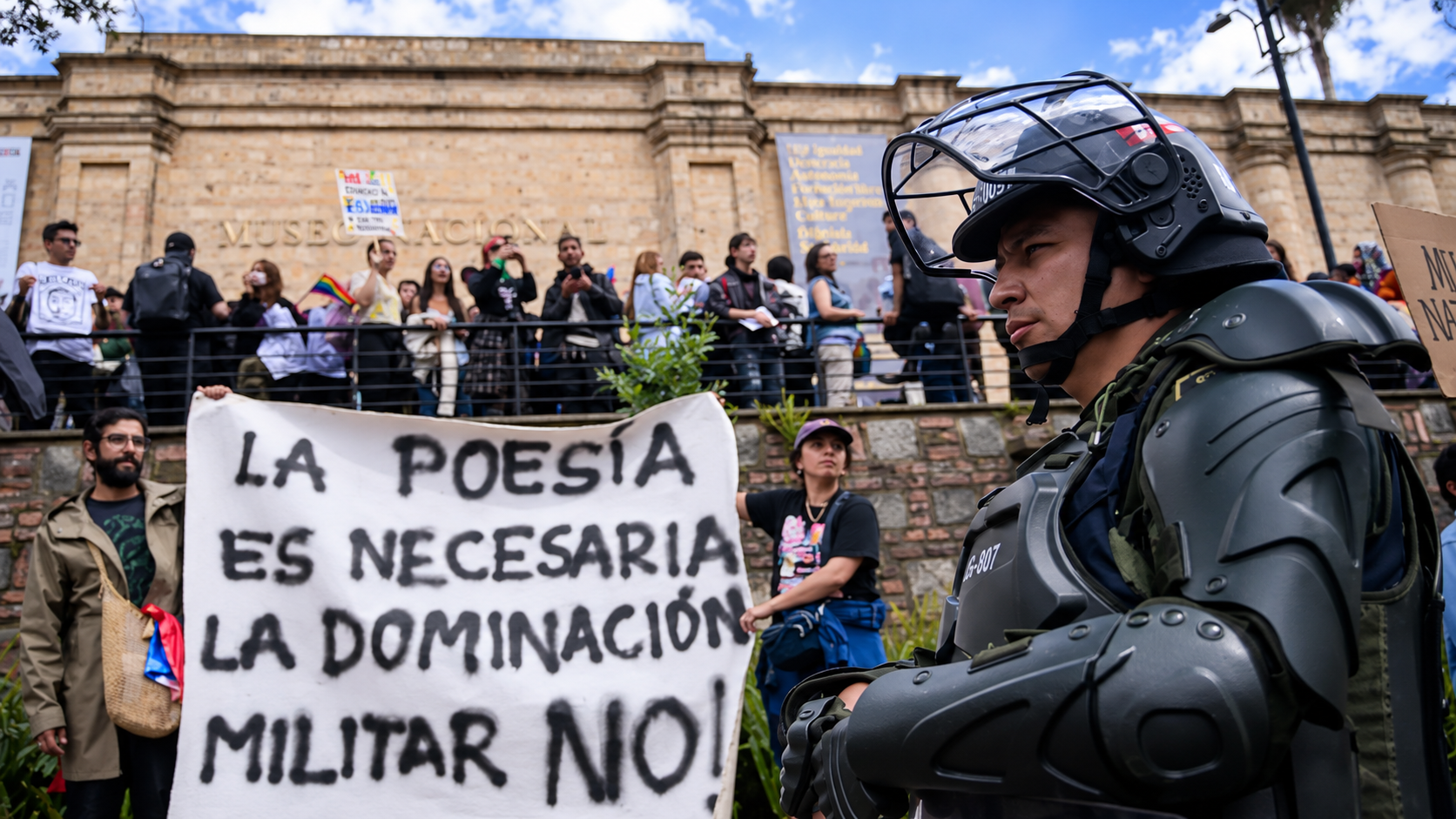
Further on October 15, the president, beside Holgin, enhanced the battle against art exhibitions about Carlos Pizarro’s campaign poster in the 1990s, feminism, and LGBTIQ+ material in the National Museum in Bogotá. The president’s speech at the ministry exposed the battle rhetoric. Subsequently, we all have “to praise the traditional family, the belief in god, loving the nation, meritocracy, and individual responsibility." One wonders about the last two on behalf of the president’s deeds. Documents published by Daniel Coronell show him receiving more than $370,000 from companies tied to Alex Saab, then his client, who pleaded guilty in Miami in September to conspiring to launder money; and his wife’s foundation, Colombia Luz y Sonrisas, registered a month before he took office, raised more than $17.3 million (COP 54.6 billion) for victims of the August 10 earthquake and by mid-October had spent only COP 11.9 million ($ 3,780). There was enough humanitarian aid, the first lady explained. The earthquake killed 335, injured 4,516, and left 103 missing.
On the other hand, the Ministry of Education has a clear path on this cultural crusade. Two women have been in office. The first, Viviane Morales, former attorney general and a radical evangelical, stayed only for a month. The second, Ilva Myriam Hoyos, who has advised the Pontifical Council for the Family and the Colombian bishops. The Constitutional Court once found she had spread reproductive rights misinformation and ordered her to correct it. Education now belongs to someone the court sent back to redo her homework. The goal, as at Culture, is to reshape the country’s history: the museum has already taken down the “Séptima Papeleta,” the 1990 student ballot behind the 1991 Constitution.
Article 19 of the constitution guarantees freedom of worship, and since 1994 the Constitutional Court has read the charter as founding a secular State. It doesn’t matter if we believe in the Virgin Mary or a flat earth; the State prefers neither. In this sense, the book prohibits using public offices to favor a religion. But the supreme crusader De La Espriella ignores the book he swore on and keeps shouting “Viva Cristo Rey” in his speeches, a cry tied to the feast of Christ the King, which Pius XI created in 1925. The same pope concluded treaties with Mussolini and Hitler’s government. The latter is still in force. A Bogotá judge ordered him to apologize on television for breaching religious neutrality. He apologized, then ended with “Viva Cristo Rey." It was obedience in the letter and contempt in the last three words. In September a higher court revoked the order, finding the cry need not be read as purely religious. Colombia’s judges now rule on how religious Christ the King is.
Enrique Serrano is one of the president’s advisors in this war. I had the unfortunate chance to meet him in class at the University of Rosario as a professor of geopolitics ten years ago; there were no signs of political alignment. At that time, the “cultural battle” wasn’t a thing, and “wokism” was seen as its roots tell, “to be alert against racism and social injustice." Serrano seeks to question the entire history of Colombia and moves closer to the Spanish creole rhetoric involved in symbols that were perpetuated by the colonization process. In 2003, in an interview with Wiston Morales, he said, “secularism is the sign of the decadence of Western religions.” A direct message to the 1991 Constitution and allegiance to the crusaders.
The war is on even in institutions that need to stay out of it. On August 19, María Carolina Restrepo, director of the Instituto Colombiano de Bienestar Familiar (Family Welfare Institute), the child-protection agency, entered into the confrontation. Henceforth, guidelines for inclusive language were made. The word “niñas" (plural for girls) is now written as “niñez” (childhood) as a word that covers “everyone." The colonization of our minds is not over. We have four long years of gods and angels ahead and a president who promised a Bible in one hand and a rifle in the other to fight crime. Given his long-standing connections to paramilitary groups, violence and intimidation are his primary tools of operation. His faith is younger than his rage.
Want to explore more, visit Samsara News!