The Navy or the Saint’s Feast: Sri Lanka's Holy Confusion Parade
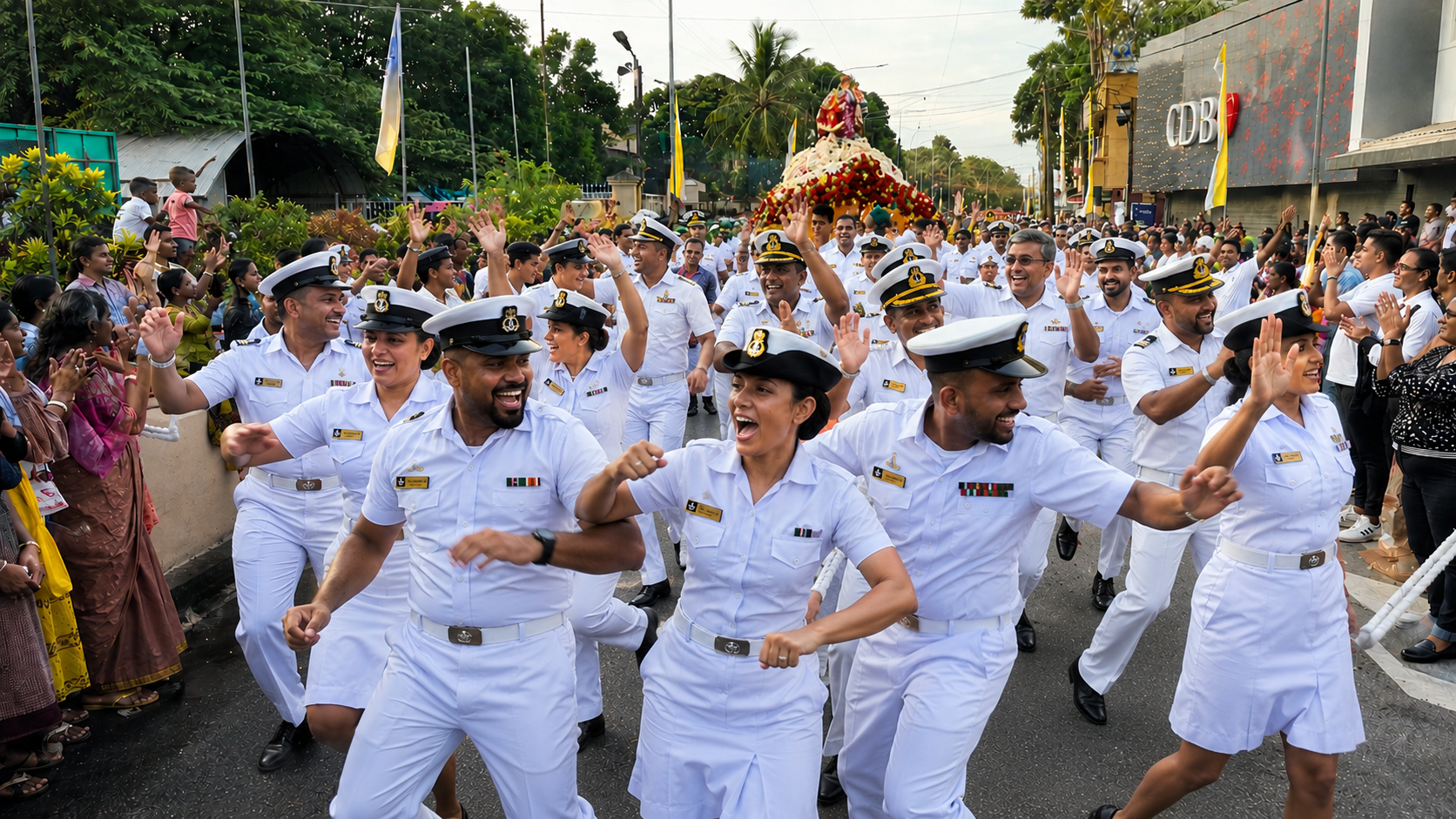
The annual St. Anthony’s Feast is celebrated once again at the National Shrine in Kochchikade, Colombo. Yet, observing the packed urban streets, one might easily mistake this solemn Roman Catholic procession for an aggressive amphibious military deployment. The Sri Lanka Navy has seemingly converted a traditional spiritual parade into a high-visibility, heavily armed exercise in mil-spec piety. White naval uniforms now blend seamlessly with liturgical vestments, proving that in modern Sri Lanka, safeguarding the eternal soul requires the exact same logistical prowess and defense presence as patrolling the volatile Palk Strait.
While conventional Catholic theology dictates that St. Anthony of Padua is represented holding the infant Jesus and a gentle white lily, the Colombo version apparently appends an armed security detail and barricades for good measure. Secular observers often erroneously assume such feasts are exclusively reserved for Roman Catholics. However, in a delightfully ironic twist of local syncretism, the Kochchikade shrine has historically drawn Buddhists, Hindus, and Muslims alike, all united in praying to a European-imported saint to miraculously resolve their very immediate, terrestrial economic crises.
Historically, the devotion to St. Anthony arrived on the island tangled tightly in the sails of Portuguese colonization in Sri Lanka. Though the historical saint was a revered Doctor of the Church, his miraculous image was utilized by invaders as an ideological medium to pacify this tropical haven. Yet, rigorous academic accuracy reveals an even deeper irony: the Kochchikade shrine actually originated during the subsequent Dutch colonial era. It was founded by Father Antonio, an undercover Indian priest fleeing strict Dutch Protestant persecution, who hid among local fishermen and allegedly performed a miracle to halt coastal erosion.
Fast forward to the modern era, and the intersection of faith, history, and military force remains intensely complicated. The tragic Easter Sunday attacks of 2019 left the Kochchikade shrine physically shattered, after which the Sri Lanka Navy stepped in as the primary architects of its structural reconstruction. Consequently, the heavy military footprint at the annual feast isn't just accidental parade confusion; it is a poignant, dark reminder of a post-war state where national security, tragic trauma, and religious devotion have become entirely indistinguishable.
As the Western Naval Command coordinates logistical amenities alongside the Archbishop of Colombo, the boundary between Caesar and God completely dissolves. This is no longer merely a religious festival; it is a masterclass in theological statecraft, where spiritual salvation arrives fully armed, flawlessly synchronized, and perfectly optimized for political consumption.
For more satirical news, visit Samsara News!