We Cry for Nothing
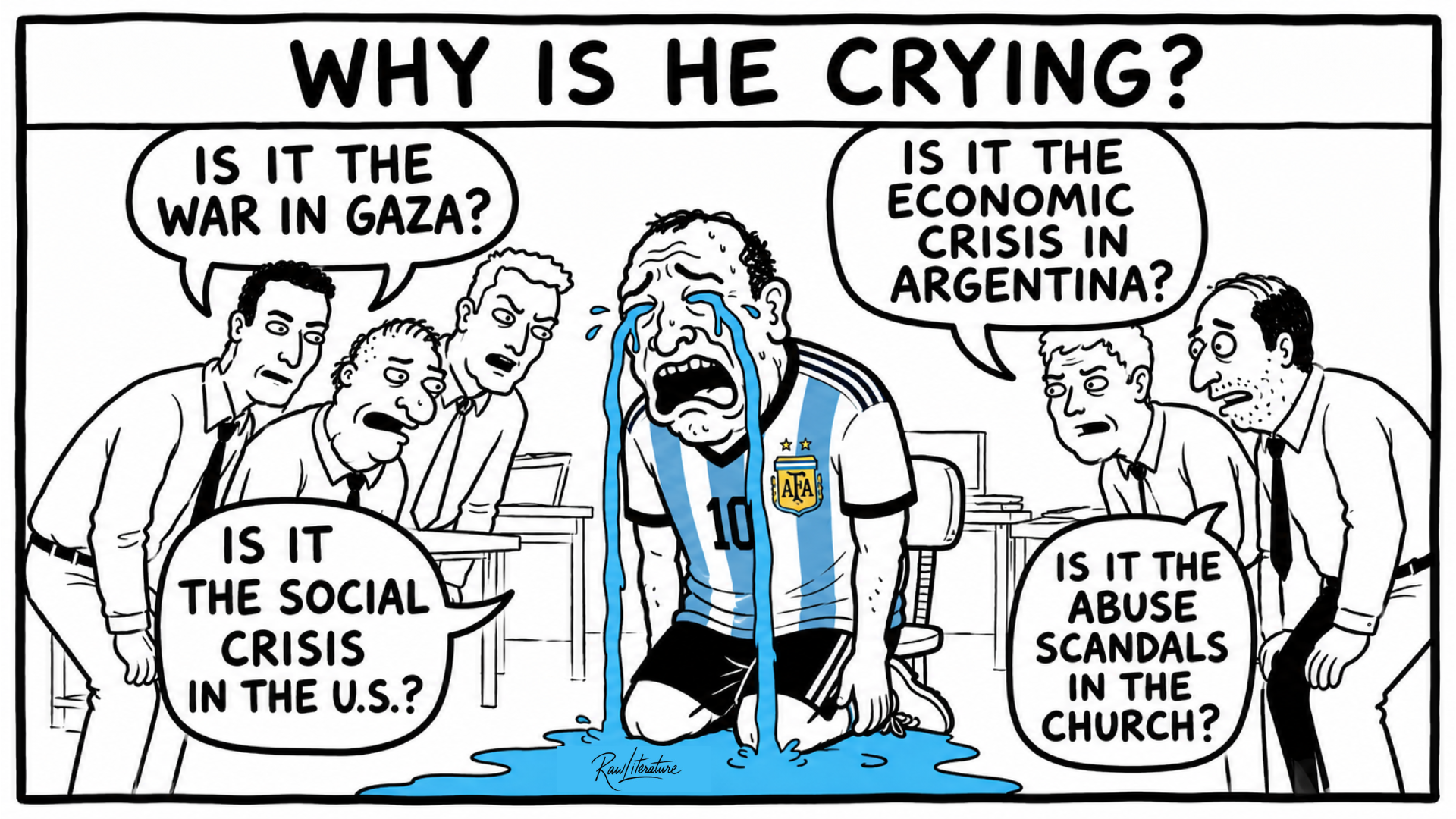
Our priorities in this modern world are overwhelmingly, hilariously out of balance, and our collective awareness of actual global affairs is even more so. Now that the world’s ultimate circus has finally lowered its curtain, we’re left staring at cameras capturing millions of grown adults weeping in unison over a victory or a defeat. Those brimming tears offer a flawless diagnostic of our civilization: a society where international solidarity is reignited the moment a leather sphere rolls into a net but vanishes when a missile tears through a classroom or cleans an entire society in the name of gods.
Millions watched Lionel Messi weep in what was framed as his final World Cup curtain call, but how many shed a single tear when a U.S. missile pulverized the Shajareh Tayyebeh elementary school in Minab, Iran, killing over 150 civilians, mostly young children? The evidence suggests far more people care about twenty-two men chasing a ball than an entire generation of children wiped out in broad daylight. Notice the existential agony when a favored national team gets eliminated. That sensation of powerlessness over a lost tournament match is apparently treated with the same emotional gravity as a terminal medical diagnosis. The exact same tears fall; perhaps one feels temporarily broken by the sheer, unbearable grief that the fragile ego suffers.
And where was this crippling sorrow when Russia’s full-scale invasion of Ukraine displaced millions of innocent families across Europe? To be sure, a brave minority in every nation protests against tyrants and oppressors, only to be beaten, silenced, or ignored by those in power; by elites who require bread, circuses, and endless warfare to stuff their blood-soaked pockets.
Consider the ongoing economic crises and skyrocketing wealth inequality strangling working classes globally. One might expect the masses, the plebeians, to revolt against the microscopic oligarchy engineering their misery. Instead, those same plebeians pawn their meager possessions to purchase astronomical tickets to a billionaire-sponsored tournament. Now they return to their homelands broke, desperate, and consoling themselves with the trauma of losing a game. Will they demand accountability from their indifferent governments? Will Argentinians attempt to impeach Javier Milei over his catastrophic austerity policies and social crisis, or will they only organize mass protests if their national team drops a final match?
And how many of us wept for the victims of systemic abuse, those left shattered by predatory figures hidden behind religious robes or white-collar elites exploiting power to subjugate the vulnerable? Where are the national days of mourning for the victims of Jeffrey Epstein or Donald Trump? No one tracks those numbers. Yet for every obscure World Cup statistic, a tear cascades down a fan's cheek. We stand in awe knowing Spain's Lamine Yamal became the youngest player in history to win both the Euros and the World Cup at just nineteen, but who truly cares to know the names of children buried under war rubble?
The World Cup circus has packed up its tents, and thank goodness we’re temporarily freed from the bread and circus. Ideally, those tears wasted over a lost match would migrate to Venezuela and translate into real political solidarity; or shift to Gaza to halt the relentless rain of bullets and the genocide since 1947; or move to Lebanon to rebuild shattered and displaced communities; or travel to Ukraine to assure people that Putin’s madness will cease before another brutal winter sets in; or flow toward South Sudan and Yemen, where human beings endure daily carnage while sports broadcasts air uninterrupted.
Why don't we cry for these realities? Is it simply because mainstream sports and culture demand zero moral courage, zero compassion, and zero sacrifice?
All of this raises an uncomfortable question about what genuine global solidarity could look like. What if the astounding billions squandered on organizing the world’s ultimate sports circus for dull minds were redirected? What if we invested those resources to empower Indigenous cultures eclipsed by global corporate and social homogenization, to advance women's rights, to protect collapsing biodiversity, and above all, to stop granting a public megaphone to an idiocracy that celebrates its own destruction?
Want to explore more, visit Samsara News!