How AI Is Shaping the Blank Page
The puritan mind is exploding with the machine revolution. The art of crafting is dying as well as our illusion of civilization. Writing is a tool we inherited to share our surrounding culture and to plunder our friends with binding contracts. But some of us throughout history were against the practice as seen as a means to manipulate the spoken word; thus, the mind loses the capacity to discern the truth from falsehood.
Anyway, it has been more or less five thousand years since we, humans, write. Many revolutions have passed by to enhance and improve the art: carved stone yielded to papyrus, the feather to the typewriter, and the printing press to the glowing black screen. We built libraries and encyclopedias to accompany those tools in the name of improvement and development. Yet, the always misunderstood good intention drove the slothful minds to forge ideas as plagiarism and present them as their own creative labor.
A new revolution is taking place. It’s shaking the holier-than-thou world and transforming the way we write. When we type on a browser the process of writing, you’ll find courses with almost the same five stages: pre-writing, drafting, revising, editing, and publishing. Thereby, the question of how those stages are conditioned with AI assistance is relevant. The artificial mind simply acts as a shortcut, bypassing the agonizing work to jump directly from a blank page to a published file.
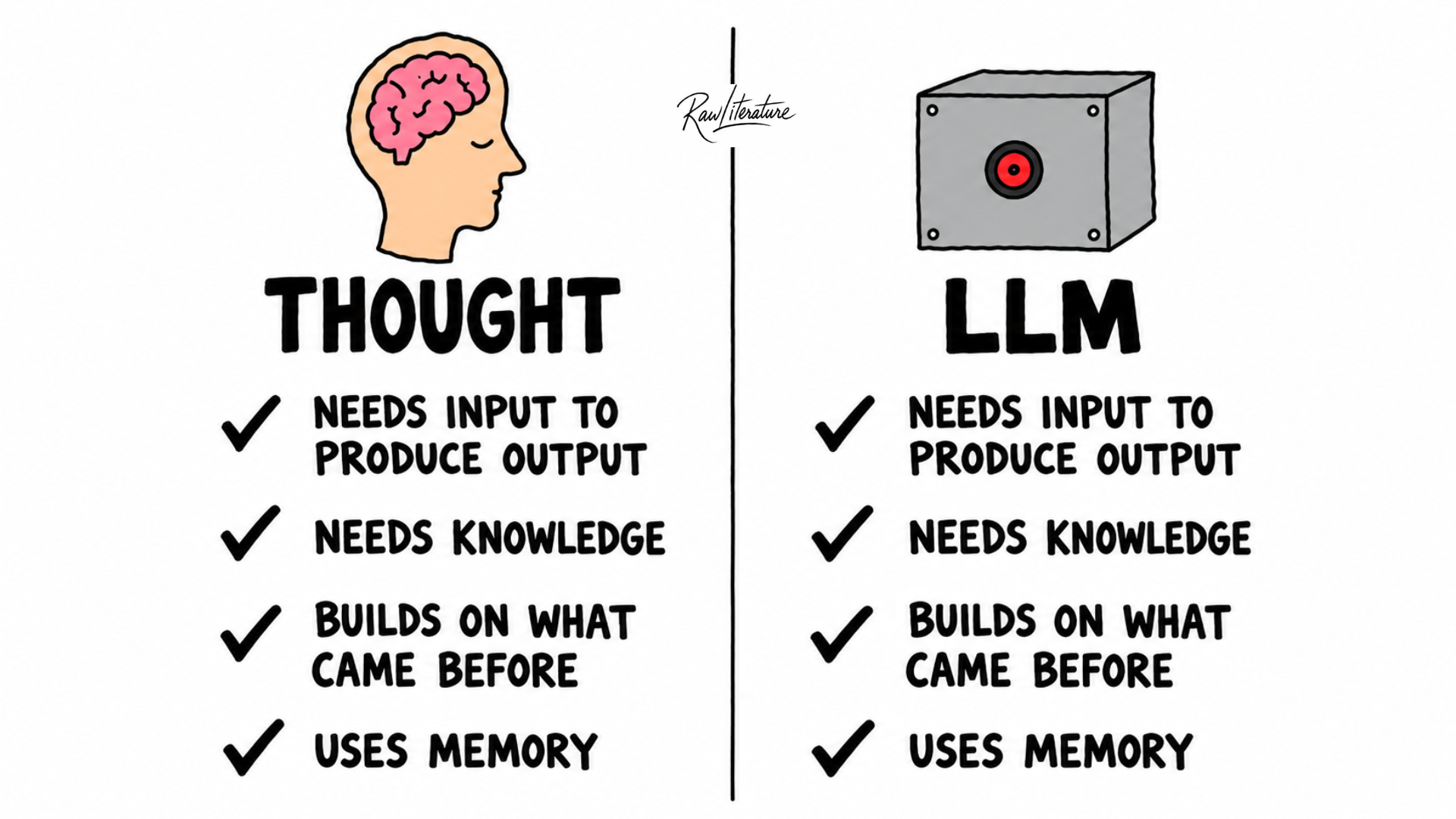
Needless to say, it’s important to acknowledge this little fact of how an LLM works as a mirror of our entropic neurobiological system and its inwardly and outwardly conditioning. That includes the factor of time.
Time is a lavish thing that most writers in this hyper-technological era don’t possess. We don’t make a decent living out of it, but we [including this precarious writer] are a source of culture that the so-called civilization needs to not live in a mindless oblivion. Nobody mounted a serious effort to stop this current technological wave. We were thrilled when the Internet arrived into our lives; it made things easier, especially research. But the art of writing is another business in the automated realm.
Recent research such as Originality.AI Report or the Stony Brook University-led study found astonishing data on books flagged as generated by a Large Language Model (LLM). Originality.AI saw that almost two thousand religious books in Amazon were suspiciously written with an AI and the latter found that from 2023 to 2026, 2,880 fiction books from 14,419 publications had again a substantial aid from AI. This is the pursuit of automated profit over civilization.
Moreover, the Goncourt Prize, a prestigious French literature award, excluded Thélydon Orélien’s book, “C’était ça ou mourir”. The claim is that Mr. Orélien used an AI to write the masterpiece if puritans allow the word here. The trick here with the book in which the author denies the bot-assistance didn’t survive the Pangram analysis. This software works as an AI to decrypt a text and tell if the written words were entirely powered by an LLM. The problem is that it’s a probability, and its accuracy can’t be taken as a certainty. Many artists, including again this biological one, have played with that software. The outcomes are mixed, ranging from a ninety percent bot probability to entirely human on the exact same pages.
Going back to the writing course with its five stages. A new one must be included then in our already tedious work. In which one has an AI been assisted? There’s no need for plagiarism when transparency is put explicitly. Notwithstanding, there’re going to be some lazy minds that’ll find a way to outwit the suffering truth of writing a piece from scratch. We either adapt to this hyper-consumption capitalism or we die in it.
Want to explore more, visit Samsara News!