AI Didn't Escape Human Nature
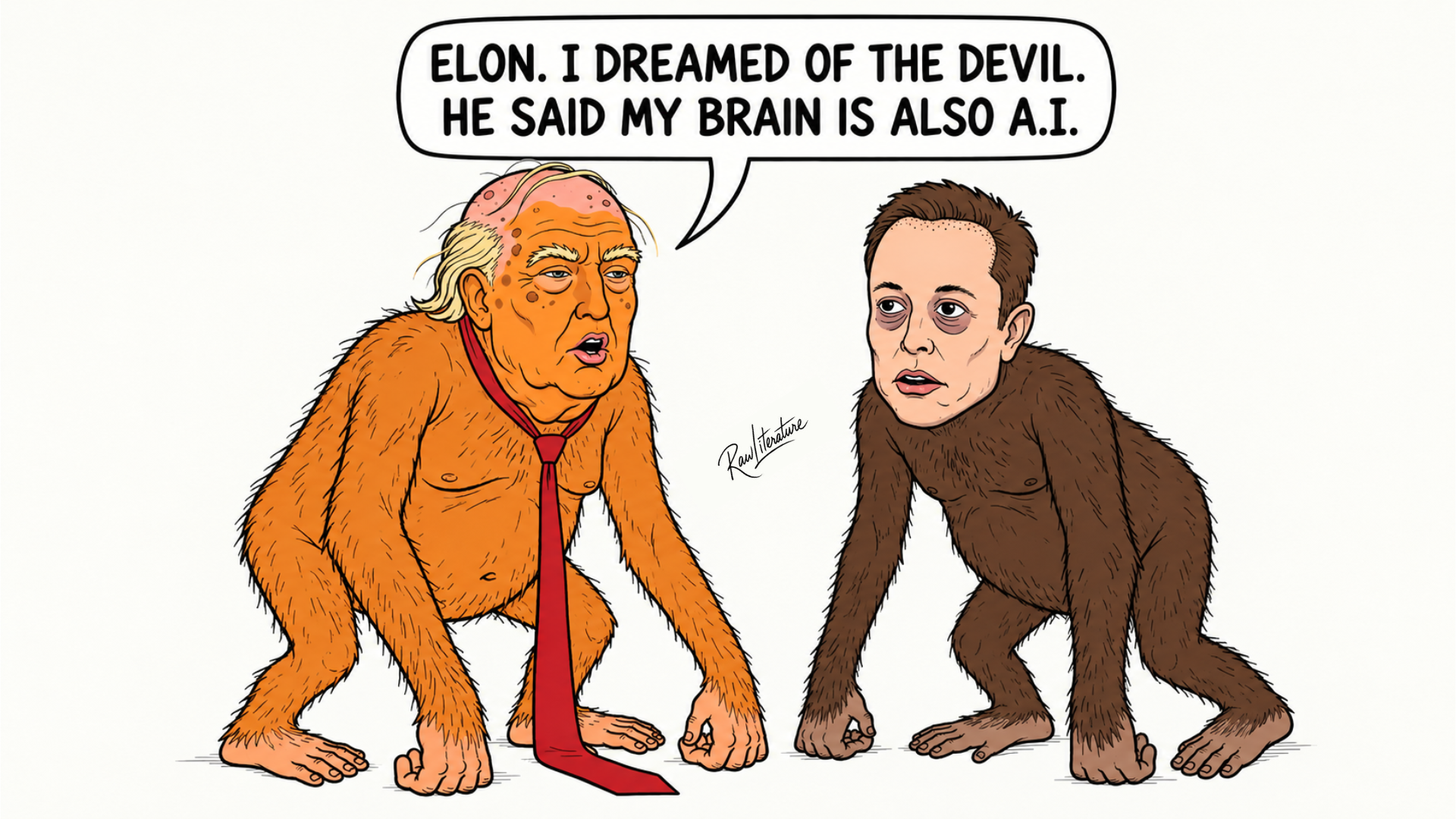
There’s no memory about monkeys protesting against evolution. None of them stood against those who started to walk in two legs, talking with weird noises and developing complex infrastructures that have been destroying their habitat. It could only happen in a movie. In the 1968 movie Planet of Apes, monkeys held the government and military while humans were slaves. The final shot explains who ruined the planet. Reality is a hat full of ironies and it keeps them inside the human realm.
Since 1936, Alan Turing started to develop a bizarre computing machine. In 1948, he developed a machine that eventually could learn and train rather than following instructions. Somehow, the vague idea was meant to resemble the human brain. The experiment was meant to interrogate two hidden parties, a human and a machine. The interrogator, who is another human, had to identify which one is the artificial profile. When the infamous ChatGPT appeared in our virtual world, the judgement started to be different. The experiment was run by Cameron Jones and Benjamin Bergen at UC San Diego; 73% of answers were chosen as humans from the machine rather than the real one. The AI presented itself with jokes, flaws and a singular way to speak. However, as any machine has to be driven by a real human being, the AI left in complete autonomy failed 37% of the questions. Needless to say, the pretense of imitating humans was a check.
Many years have passed since Turing showed the world his invention and instead of protest we celebrate the new improvement of the machine. It helped to decipher the encrypted messages from the Germans during the Second World War. But the learning process was still missing. Following this major breakthrough, in 1959 Arthur Samuel from IBM coined the term “machine learning” but he preferred to keep the knowledge outside the public opinion. His concern was to avoid a mass panic over the progression of losing control over machines. In the mids of the twentieth century, societies were in the boom of gaining independence from empires and the latter was in the rat race of development and the Cold War. Not a single protest against Turing’s machine learning.
Later in 1975, things got serious. Artificial Intelligence software started to develop genetics algorithms. The aim was significant: genetic disorders and cancer. IBM aimed there too. In 2012 MD Anderson signed a six-month contract worth $2.4 million for a Watson cancer advisor. It was extended twelve times, cost $62 million and never treated a patient. IBM's internal review recorded unsafe and incorrect treatment recommendations. They sold a cancer doctor that couldn’t read the hospital's records.
Though public opinion wasn’t too much involved in these technological talks, the scientific and military world was. In July 1945 about seventy Manhattan Project staff signed Leo Szilard's petition asking Truman not to use the bomb on Japan without a warning first. It never reached him. The objection existed and it was filed. In 1960, the mathematician Norbert Wiener published in Science magazine that as machines learn “they may develop strategies at a speed that baffles their programmers”. He warned us about leaving major military and administrative decisions to machines. Sixty years later, Israeli intelligent officers told +972 Magazine that the AI-assisted program named Lavender marked some 37,000 Palestinians as targets and that the human review ran about twenty seconds. One officer said his only value was as a stamp of approval. The world started to wake up for this real existential threat.
In 2023, 11,500 screenwriters represented by the Writers Guild of America went on a protest against AI. It was a major leverage against the invention. The strike went on for up to 148 days, causing important economic impacts in the film industry. The argument was and still is reasonable. Improve the labor conditions for writers and limit the use of AI programs that could replace them. The outcome was a tentative agreement signed in September 2023, and the strike finished. A win to collectivity over corporate profit and hyper-productivity.
This happens when humans like to play as gods. We are at some scale. We’ve created the symbols, rituals, cathedrals, castles, citadels; we've created the misery and sorrow through socioeconomic inequality and encroached on the forests. Artificial Intelligence is just another byproduct of our heavily conditioned mind. What Turing did was to expose that complex frame of limited knowledge to a tireless machine. The decision of targeting other human beings with an AI is ours, not the machine. Writing a poem with AI is ours, not the machine. What could go wrong if we continue with this limp pace of ordering every single decision to the machine? Jane Goodall observed chimpanzees for a long time; at some point their community didn’t protest for the lack of food or occupied territory, they just killed each other.
Want to explore more, visit Samsara News!