Copyright vs. Children
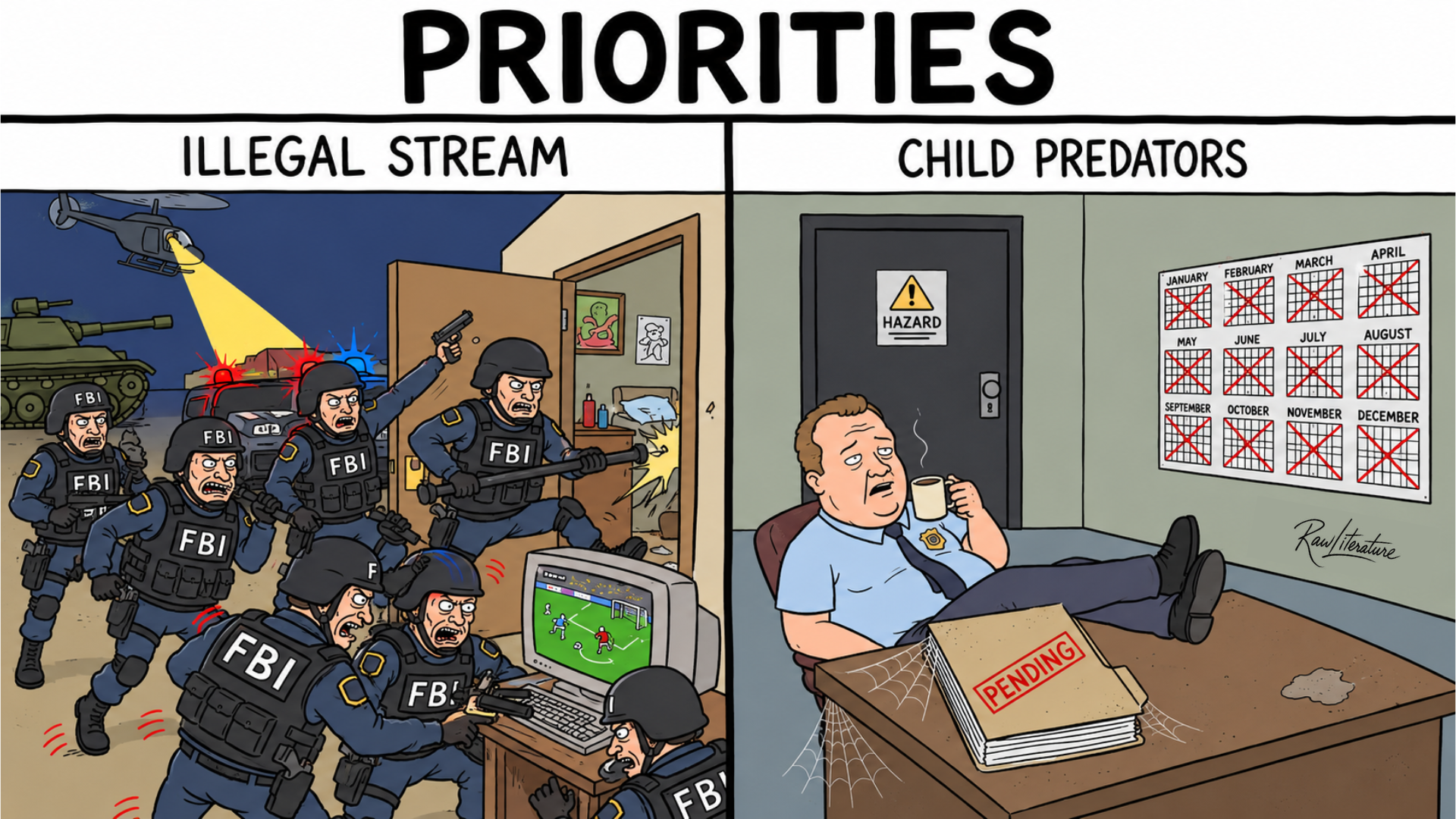
Here’re a few dazzling metrics that crossed my desk just as the World Cup is blowing its final whistle, allowing humanity to safely return to the crushing monotony of ordinary existence. While billions cheered for a kicked, leather ball, a grim reality played out in the digital shadows: during that single month of corporate-sponsored athletic frenzy, statistic frameworks from the Internet Watch Foundation and UNICEF indicate that approximately 1 in 12 children globally were exposed to online sexual exploitation or abuse. That means roughly 300 million minors missed out on the pristine joy of the tournament because they were busy being victimized by the dark underbelly of the web.
Meanwhile, in a parallel universe of uncompromised systemic urgency, a much graver tragedy was averted: the unauthorized streaming of football matches. Millions of dollars were instantly injected into a global corporate defense apparatus to halt the unauthorized distribution of games outside approved legal boundaries, forbidding a broke fan from emptying their already depleted wallet anywhere else but into the waiting hands of private subscription channels.
The Golden Rule of Modern Jurisprudence: A corporate logo must be shielded with uncanny speed; human flesh, however, can wait for a committee review and an international non-binding resolution.
Setting up this analogy allows us to spot the true, unvarnished priorities of our international legal framework. It’s a system beautifully engineered to safeguard the emotional well-being of media conglomerates. When the hearts and minds of the masses are transfixed by a strategic kick, the machinery of state and capital functions with poetic clarity.
One might naively assume that protecting the future of our species would occupy the apex of global law enforcement priorities. The reality, of course, laughs in the face of such sentimentality. For a website promoting digital child abuse, the international legal apparatus routinely requires between two to five years to successfully investigate, clear cross-border jurisdictional hurdles, and counter the crime. Criminals nimbly exploit this bureaucratic lethargy, setting up dynamic mirror sites across bulletproof hosts while authorities fill out regional paperwork. Time is apparently an infinite luxury, unless, of course, you’re streaming a live match in high definition.
Enter the sporting counterpart. The World Cup burns brightly for a mere month, yet the logistical defense architecture deployed by television networks and digital rights holders operates like an allied army on the brink of total war. Outsourcing their cybersecurity to elite private firms armed with automated takedown algorithms, these cartels managed to track, intercept, and terminate over 1,400 illicit streaming websites in absolute record time.
This stark portrait of civilizational contradictions should take your breath away. How did a brief athletic spectacle secure more rapid, ironclad protections than the psychological safety of our youth? The answer is as simple as it’s absurd: money talks, while human rights merely file complaints. A child is a child whether in London or the furthest corners of the global south, but a live broadcast commodity apparently enjoys far more legal agility, financial backing, and sovereign protection than the very future of the human race.

Verified via primary legal and enforcement data from the Federal Court of Canada (Bell Media v. John Doe), Europol (Operation Alice, 2026), and the Canadian Centre for Child Protection (Project Arachnid)
Want to explore more, visit Samsara News!