The Violent Togetherness of the World Cup
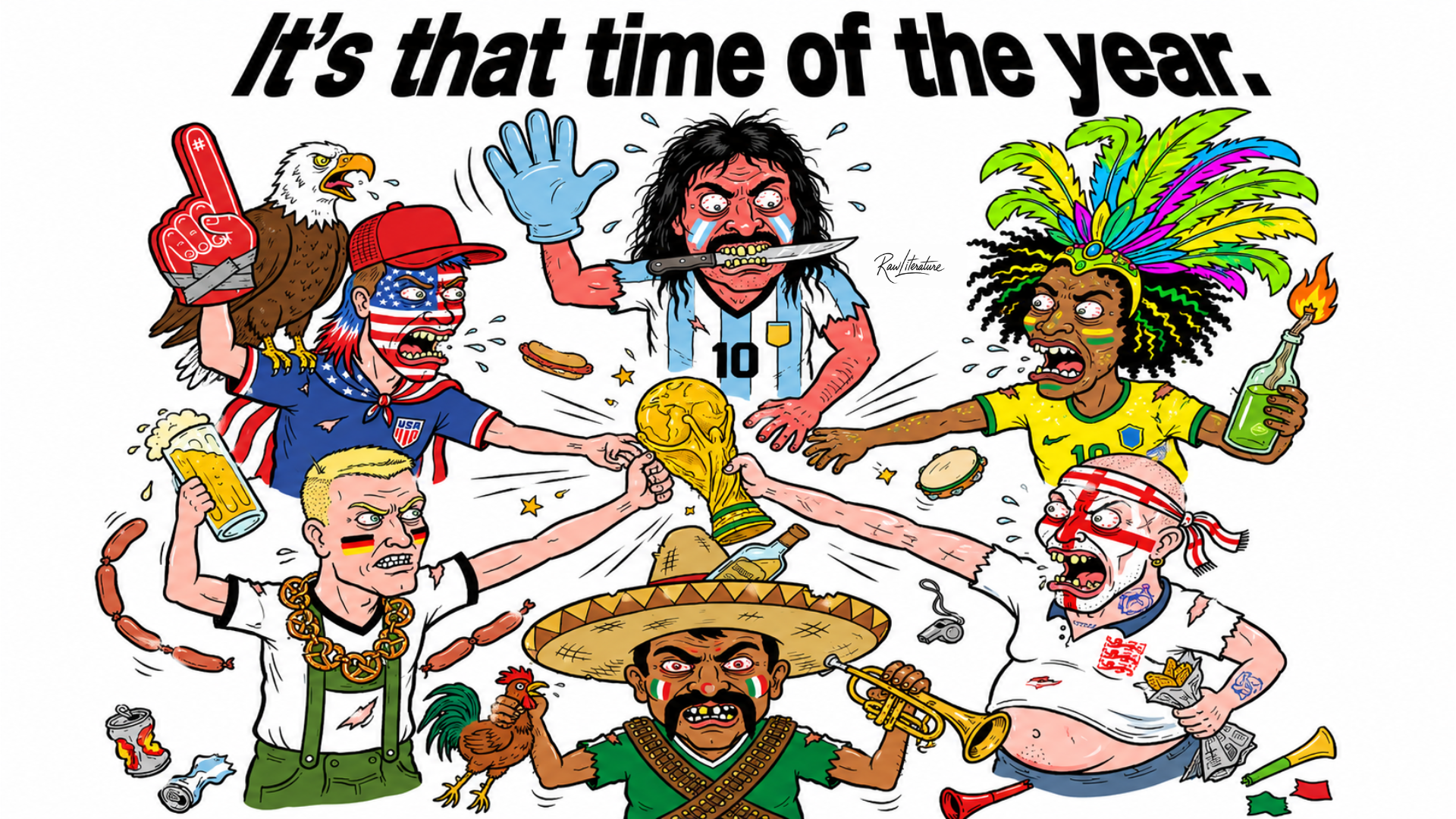
It has been a mere four days since the kick-off of the FIFA World Cup 2026, yet global football fans have already bared their sharply manicured nationalist claws. Toss anyone wearing a cheap-copied polyester jersey into a volatile cauldron of bottom-shelf alcohol and primitive patriotic adrenaline, and an explosive physical clash becomes an absolute mathematical certainty.
Once upon a time, this lucrative sporting circus was marketed as a wholesome “family plan,” where tribes supposedly gathered in multi-colored harmony. A pre-match feast, shared laughter, standard intoxication, and pretentious tactical analogies comparing back-passes to political philosophies served as the decorative veneer. The “beautiful game” was, briefly, beautiful in its entirety. Today, the seismic vibration of supporters' chants and collective goal hysteria serve only as a melancholic eulogy for a sport that no longer exists in its pure form.
However, when billions treat mainstream entertainment as an infallible religion and politicians weaponize it for statecraft, institutionalized football fan violence becomes entirely inevitable. It’s not an isolated World Cup symptom; it’s the recurring pathology of every major sporting event where collective mobs and organized hooligans congregate. Humanity enters an oblivious, primal state when swept up in this tribal torrent. We maim in the name of God, slaughter for the flag, and bludgeon for the club badge, and then we codify this psychopathy under the noble euphemism of being a “true supporter" or “truly patriotic."
In nations where football hooliganism is deeply embedded within the socioeconomic fabric, such as England's historical firms, Argentina’s mafia-like Barras Bravas, Brazil’s heavily armed Torcidas Organizadas, or Italy’s politically radicalized Ultras, these violent syndicates operate as hyper-efficient cartels. They control entire neighborhoods, dictate club executive decisions, extort directors, and wield exclusive ticketing monopolies, maintaining their front-row presence even when the national team travels to prestigious tournaments like the World Cup (you’ll meet them). Academic studies in sports sociology consistently confirm that these groups act as the unofficial paramilitary arms of local political factions.
Take the viral footage currently flooding social media: hours before their Group J match in Kansas City, Argentine and Algerian supporters staged a massive, unsanctioned UFC street fight right in the middle of New York's Times Square, sending terrified tourists fleeing from a hail of punches, kicks, and flying glass. Naturally, the purists dismiss this as “football folklore.” “This is just how we express our togetherness,” one concussed, black-eyed enthusiast proudly declared to reporters immediately after catching a stray beer bottle with his cranium.
Children absorb these spectacular exhibitions on television and live inside the host cities, their innocent dreams thoroughly conditioned by the barbaric theater of their elders. Yet, it’s all beautifully educational. There’s truly nothing more pedagogical for the next generation than watching grown men rupture each other's jawbones in the street, all while the stadium loudspeakers overhead deafeningly blast hypocritical corporate anthems of “world peace” and FIFA's hollow mantra of “Fair Play.”
The multi-billion-dollar show must go on. The vibrant flags and festive masquerades are undeniably part of the romantic folklore. But how do we reconcile the celebration with such profound brutality? The tribal warfare has expanded beyond the concrete streets into the toxic digital trenches of the internet. Our ideological fragmentation has bypassed the boundaries of rational comprehension; sociologists and anthropologists are left bewildered by a collective behavioral regression that feels utterly decoupled from modern humanity. It’s a 100% mind-manufactured crisis, and as the stadiums fill, a real solution remains nowhere in sight.
For more satirical news, visit Samsara News!