The Submission Diplomacy of the Subsoil
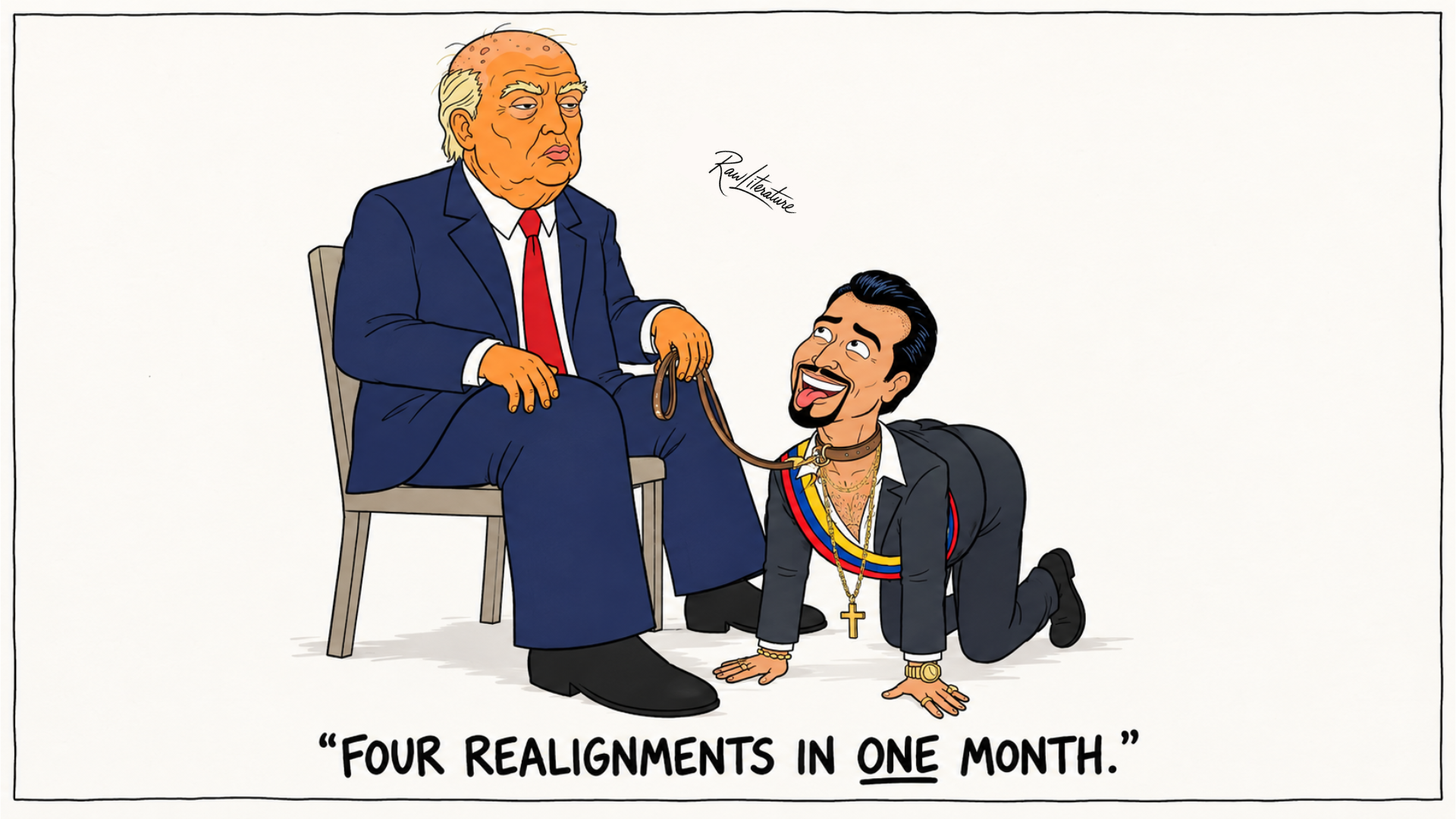
After four years of Gustavo Petro’s “Law of Similars” doctrine under which all countries are treated equally, the new president, Abelardo De La Espriella, has restored Colombia’s traditional posture: to look at the North Star again. Abelardo’s administration has made his geopolitical servility and obedience his primary exports. This means literally bending over to the power of the White House where a fart from Donald Trump could smell like flowers in the nation of Macondo.
The formal ceremonial renewal of this patronized relationship took place in Barranquilla during an official visit by U.S. Secretary of State Marco Rubio last September 8. In normal times, this kind of high-level visit takes place at the Palacio San Carlos, in Bogota, where the diplomatic headquarters are located. To accommodate the American delegation, De La Espriella hosted the summit at a lavish tax-funded estate modeled after the White House. A solemn proof of De La Espriella’s American citizenship and multi-jurisdictional loyalties that legal scholars criticized prior to the elections. In any case, Foreign Affairs Minister Bula arranged the proceedings with the meticulous discipline of a butler preparing a deed transfer, ensuring that national sovereignty was executed with formal precision as a gift to the decaying empire.
The encounter brief is in a Memorandum of Surrender granting Washington priority access to Colombia’s minerals: lithium, cobalt, nickel, and seventeen critical rare earth elements such as lanthanides, scandium, and yttrium. These are the physical backbone of your modern laptops and smartphones, artificial intelligence hardware, and guided missile systems. In an era defined by global military rearmament and AI races, the agreement formalizes the extreme exploitation and future forced displacement of marginalized communities. Colombia surrenders its geological inventory under the guise of bilateral submission.
A second memorandum outlines bilateral cooperation in civil nuclear energy, promising high-tech power generation to a nation where remote regions still living in the nineteenth century. Foreign Minister Omar Bula framed the nuclear pact as a leap into the twenty-first century, despite Colombia lacking the technical infrastructure, regulatory oversight, knowledge, or financial capital required to operate a reactor. The agreement serves no immediate practical purpose beyond establishing a binding political barrier against the Chinese presence in the region. By signing a contract for technology it cannot build or afford, Colombia’s executive offers a performative promise of progress designed entirely to reassure Washington that the State remains safely insulated from multipolar economic alliances.
In exchange for critical minerals and geopolitical exclusivity, Marco Rubio offered a renewed pledge of military assistance for Colombia’s endless internal counter-narcotics campaign that failed in previous assistance and will do hereafter. This promise mirrors Trump’s election interference with his senile declarations of a one-billion-dollar defense injection, a figure that remains entirely unseen by the United States Congress. The bilateral exchange reveals a remarkably transparent transaction: immediate, uncompensated access to strategic natural resources in return for a speculative ledger of foreign military funding. Decades of structural violence and cartel operations are reduced to a transactional baseline, confirming that Colombia’s territorial control continues to be auctioned off for foreign security subsidies that may never actually arrive.
Want to explore more, visit Samsara News!